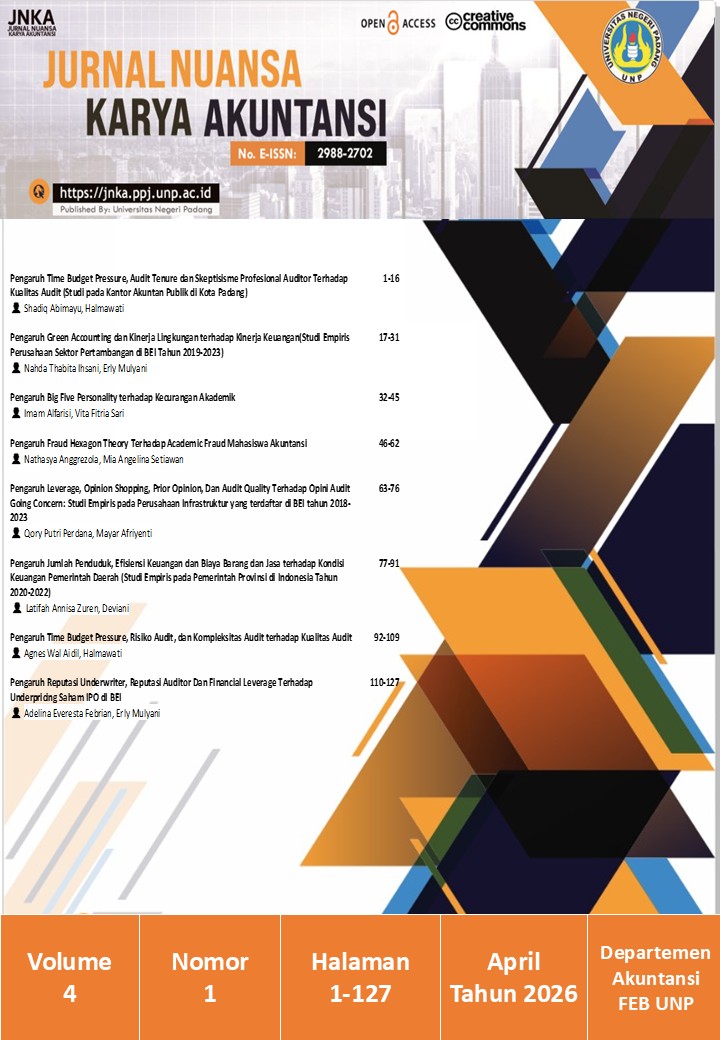
Pengaruh Big Five Personality terhadap Kecurangan Akademik
DOI:
https://doi.org/10.24036/jnka.v4i1.97Keywords:
personality characteristics, academic circumstances, big five personalityAbstract
The purpose of this study is to identify and examine how the Big Five personality characteristics affect academic settings. This study falls under the category of quantitative associative causation research. A questionnaire that was given to accounting students at Padang State University, Bung Hatta University, and Andalas University was used by researchers to gather data. Primary data was used in this study. In this instance, test the hypothesis. IBM SPSS's multiple linear regression analysis is used in the study. The study's findings demonstrate that extraversion has a favorable and noteworthy impact on academic circumstances. Academic conditions are not much impacted by personality agreement. Academic situations are significantly impacted by conscientiousness. Academic situations are significantly impacted by personality neuroticism. The openness to experience personality does not have a significant effect on academic conditions
References
Alalehto, T. (2003). Economic crime: Does personality matter? International Journal of Offender Therapy and Comparative Criminology, 47(3), 335–355. https://doi.org/10.1177/0306624X03047003007
Anderman & Murdock. (2007). Physycology Of Academic Cheating. Psychology of Academic Cheating, 34.
Barrick, M. R., Mount, M. K., & Judge, T. A. (2001). Personality and Performance at the Beginning of the New Millennium: What Do We Know and Where Do We Go Next? International Journal of Selection and Assessment, 9(1–2), 9–30. https://doi.org/10.1111/1468-2389.00160
Blickle, G., Schlegel, A., Fassbender, P., & Klein, U. (2006). Some personality correlates of business white-collar crime. Applied Psychology, 55(2), 220–233. https://doi.org/10.1111/j.1464-0597.2006.00226.x
Elias, M. J. (2009). Social-emotional and character development and academics as a dual focus of educational policy. Educational Policy, 23(6), 831–846. https://doi.org/10.1177/0895904808330167
Feist, J., & Feist, G. J. (2009). Theories of personality (7th ed.). McGraw-Hill.
Giluk, T. L., & Postlethwaite, B. E. (2015). Big Five personality and academic dishonesty: A meta-analytic review. Personality and Individual Differences, 72, 59–67. https://doi.org/10.1016/j.paid.2014.08.027
Goldberg, L. R. (1990). An Alternative “Description of Personality”: The Big-Five Factor Structure. Journal of Personality and Social Psychologs, 59(6), 1216–1229. https://doi.org/10.1117/12.642204
Graziano, W. G., & Tobin, R. M. (2002). Agreeableness: Dimension of personality or social desirability artifact? Journal of Personality, 70(5), 695–728. https://doi.org/10.1111/1467-6494.05021



1.png)